If you are reading this in 2026, you know that the manufacturing strategies used five years ago are obsolete. The global landscape has shifted. While labor arbitrage still exists, it is no longer the only driver of competitive advantage.
Today, procurement leaders face a “Trilemma” of challenges: Global Inflation, unpredictable Geopolitical Friction, and strict Sustainability (ESG) regulations. A supplier offering the lowest unit price is useless if the goods are delayed by trade tariffs or rejected by customs for failing environmental standards.
In the current market, “Low Cost” has evolved. It’s not just about finding the cheapest factory; it’s about finding the most efficient and reliable supply chain.
What is Low Cost Country Sourcing in 2026?
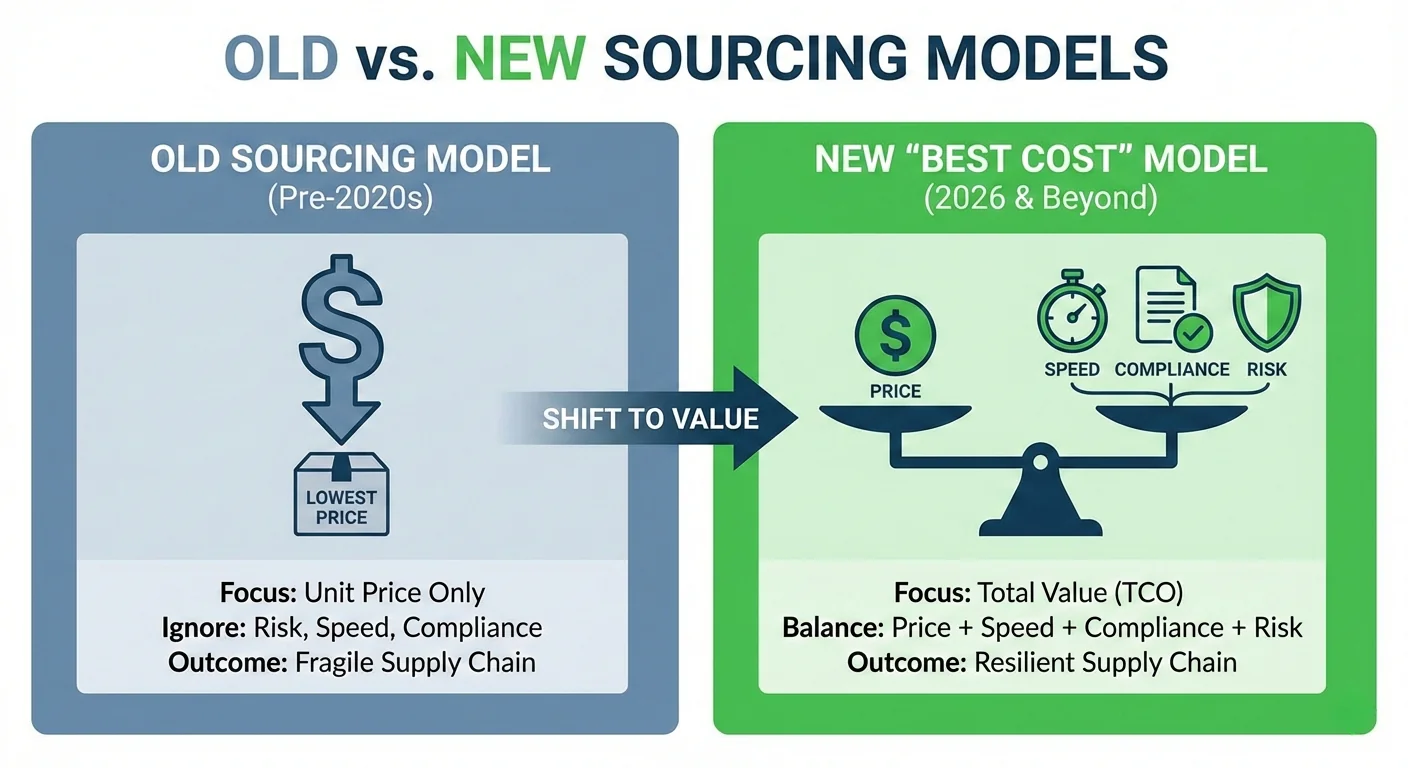
Low Cost Country Sourcing in 2026 is a strategic approach that prioritizes the Total Cost of Ownership over simple unit price. It involves sourcing from regions that offer the best balance of labor costs, infrastructure maturity, and political stability—often referred to as “Best Cost Countries.”
What You Will Learn in This Guide Navigating this complex landscape requires data. In this comprehensive guide, we provide actionable intelligence for your 2026 procurement strategy:
- The 2026 Sourcing Map: A detailed look at top manufacturing hubs, including Vietnam, India, and nearshoring options like Mexico.
- The “China Plus One” Strategy: How to diversify your supply chain without losing efficiency.
- Risk Management: How to vet suppliers for quality and compliance in a volatile market.
What is Low Cost Country Sourcing in 2026?
To understand sourcing in 2026, we must first redefine the term.
Low Cost Country Sourcing (often abbreviated as LCCS) is defined as the procurement strategy of sourcing materials or manufacturing services from countries with lower labor and production costs than the buyer’s home country.
However, in the current economic climate, the definition has shifted. Leading supply chain experts now refer to this strategy as Best Cost Country Sourcing.
The Shift: From “Low Cost” to “Best Cost” In the past, the primary goal was simply to minimize wages. In 2026, Best Cost Country Sourcing focuses on value. It seeks regions that offer the optimal combination of competitive costs, high-quality infrastructure, skilled labor, and low geopolitical risk. It is not about the cheapest price tag; it is about the best total value.
Core Drivers for Global Sourcing in 2026 Why are companies continuing to move production despite global challenges? The motivation has moved beyond simple arbitrage. The three primary drivers include:
- 1. Cost Reduction (Labor & Materials) While the gap in wages is narrowing, manufacturing in countries like Vietnam or India still offers significant savings compared to Western markets. In 2026, companies are also looking for proximity to raw materials to reduce logistics costs and shield themselves from energy price spikes.
- 2. Supply Chain Diversification (Risk Management) Relying on a single country for 100% of production is now considered a critical business risk. The “China Plus One” strategy has become standard practice. Companies diversify their sourcing footprint to ensure that a disruption in one region—whether political, climatic, or logistical—does not shut down their entire global operation.
- 3. Market Access Sourcing is no longer just about export. Many “Low Cost Countries” have transformed into massive consumer markets. Establishing manufacturing hubs in regions like Southeast Asia or Latin America allows companies to bypass import tariffs and gain direct access to millions of new, emerging middle-class consumers.
Top Sourcing Destinations for 2026: The “Best Cost” Matrix
Choosing the right location in 2026 is no longer just about the lowest hourly wage; it is about matching the location’s strengths with your specific product lifecycle and risk tolerance. We have categorized the top global sourcing hubs into three strategic clusters.
1. The “China Plus One” Stars (Southeast & South Asia)
For companies executing a China Plus One strategy to diversify supply chains while staying within the Asian component ecosystem, these are the most mature alternatives.
- Vietnam (Electronics & Textile Contract Manufacturing)Vietnam remains the primary winner of recent supply chain shifts. By 2026, it has evolved from simple assembly to a sophisticated hub for consumer electronics, PCB assembly, and high-volume garment manufacturing.
- Why here: It offers the most “China-like” manufacturing ecosystem. It is ideal for OEM (Original Equipment Manufacturer) projects that require deep integration with global shipping routes.
- India (Precision Engineering & Pharma)India is the answer for massive scale. It is a top choice for active pharmaceutical ingredients (API), IT Services, and increasingly, precision engineering and metals.
- Why here: The government’s Production Linked Incentive (PLI) schemes have significantly boosted competitiveness. India is the best alternative for labor-intensive industries facing workforce shortages elsewhere.
- Thailand (Automotive & High-Mix Assembly)Known as the “Detroit of Asia,” Thailand maintains its dominance in automotive parts manufacturing and mid-tier electronics.
- Why here: Excellent infrastructure and a mature supplier base make it a safe choice for complex assembly that requires skilled technicians rather than just cheap labor.
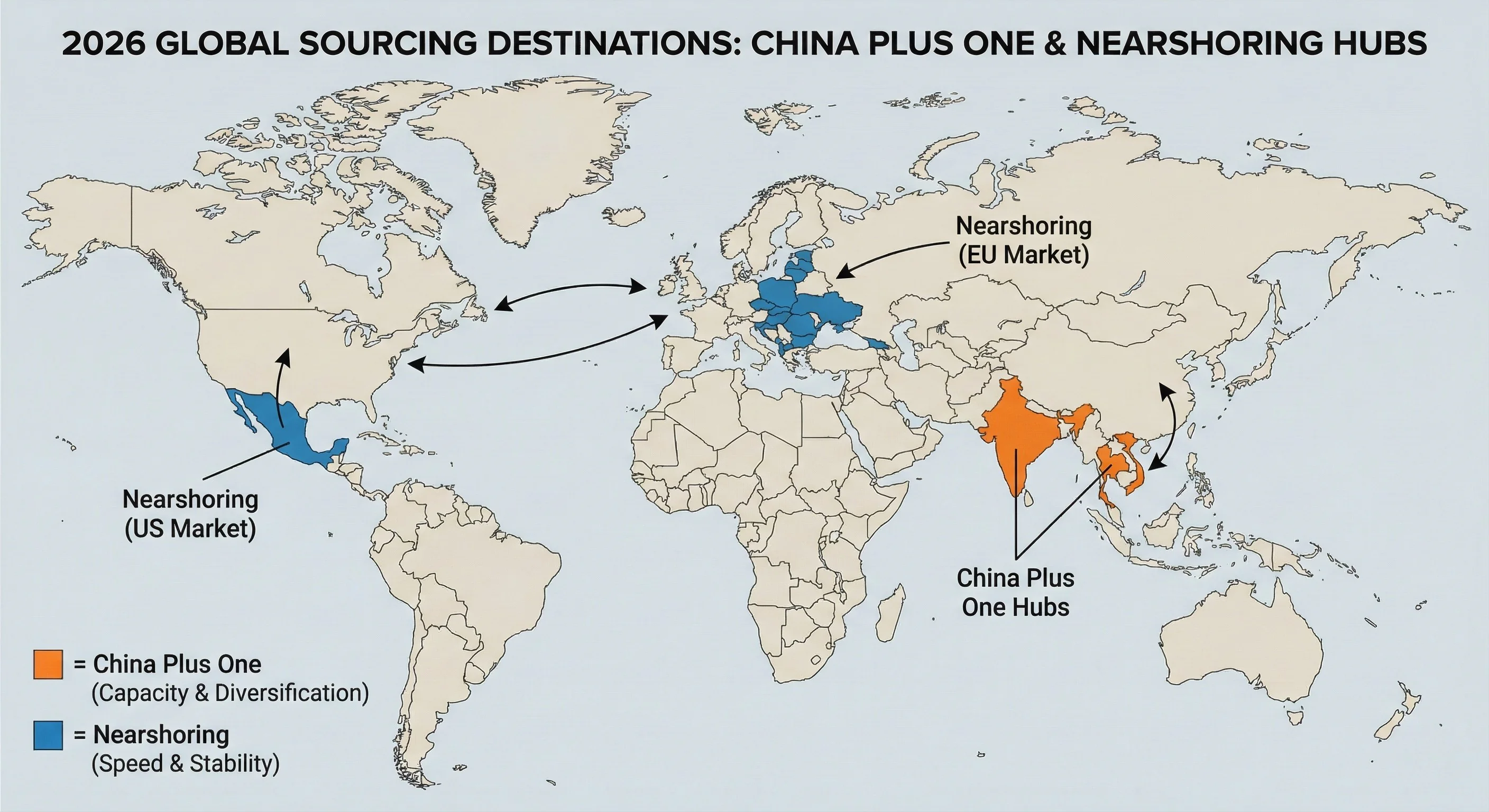
2. Nearshoring Champions (Speed & Tariff Reduction)
For brands selling to US or EU markets, 2026 is the year of Nearshoring. The primary goal here is reducing lead times and cutting freight costs.
- Mexico (The US Nearshoring Hub)Mexico is the premier sourcing destination for the US market, particularly for injection molding, appliances, and aerospace components.
- Why here: The USMCA (United States-Mexico-Canada Agreement) allows for duty-free trade. Utilizing the Maquiladora program (IMMEX) allows foreign companies to import raw materials tax-free for assembly.
- Key Benefit: Shipping goods from Monterrey to Texas takes days, not weeks.
- Eastern Europe: Poland & Romania (EU Nearshoring)For EU-based companies, Eastern Europe offers the perfect “Best Cost” balance.
- Why here: These countries offer high-skilled labor suitable for industrial machinery and IT. Being within the EU Single Market means zero tariffs, no customs delays, and seamless truck logistics.
3. Emerging Frontiers (Raw Materials)
- Indonesia & MalaysiaThese nations are critical for resource-based processing (rubber, palm oil) and the EV battery supply chain (Nickel). They are becoming key nodes for component manufacturing in the green energy sector.
Comparison: Low Cost Country Sourcing vs. Best Cost Country Matrix 2026
| Destination | Top Manufacturing Industries | Labor Cost Trend (2026) | Logistics Lead Time | Ideal For Strategy |
| Vietnam | Electronics, Apparel | ↗️ Moderate Rise | Medium (Ocean Freight) | China Plus One |
| India | Pharma, Engineering | ➡️ Stable | Medium (Improving) | Scale & Diversification |
| Mexico | Auto, Injection Molding | ↗️ Rising | Fast (Truck/Rail) | Nearshoring (US) |
| Poland | Machinery, IT | ↗️ High | Fast (Truck) | Nearshoring (EU) |
| China | All Categories | ↗️ High | Fast (Mature) | Complex Components |
Why Sourcing Overseas? It’s Not Just About the Price Tag
Sure, saving money is great. But in 2026, smart brands use global sourcing to grow faster, not just cheaper. Here is why moving production to a Low Cost Country (LCC) is a strategic power move for your business.
1. Scale Up Without the Overhead (Operational Efficiency)
Building your own factory is expensive and risky. What if demand drops next year?
- The Win: Sourcing allows you to plug into existing infrastructure in places like Vietnam or India. You get economies of scale instantly.
- Real Talk: You can double your production volume for the Christmas rush without buying a single new machine. That’s flexibility.
2. Do What You Do Best (Focus on Core Competencies)
Are you a manufacturing company, or are you a design and marketing company?
- The Win: By outsourcing the “heavy lifting” of production, your team stops worrying about factory maintenance and raw material shortages.
- Real Talk: Let the factory experts handle the assembly. You focus your energy on R&D and selling your product. This is the “Asset-Light” model that tech giants use to stay agile.
3. Work While Your Competitors Sleep (24/7 Operations)
Time is money. When you source globally, you turn time zones into an advantage.
- The Win: While your US or European team is sleeping, your production line in Asia is running at full speed.
- Real Talk: This creates a continuous 24-hour workflow. You send a design update on Monday evening, and wake up to a finished prototype on Tuesday morning. This drastically cuts your Time-to-Market, getting your product on shelves before the competition.
The Hidden Risks of Low Cost Country Sourcing (And How to Fix Them)
Let’s be honest: Sourcing from a new country offers huge rewards, but it isn’t risk-free. If it were easy, everyone would be doing it perfectly.
In 2026, the landscape has changed. It’s not just about a shipment arriving late; it’s about compliance, legal liabilities, and maintaining your brand’s reputation. Ignoring these risks doesn’t just cost money—it can shut down your business.
Here are the four biggest challenges procurement managers face today, and practical ways to handle them.
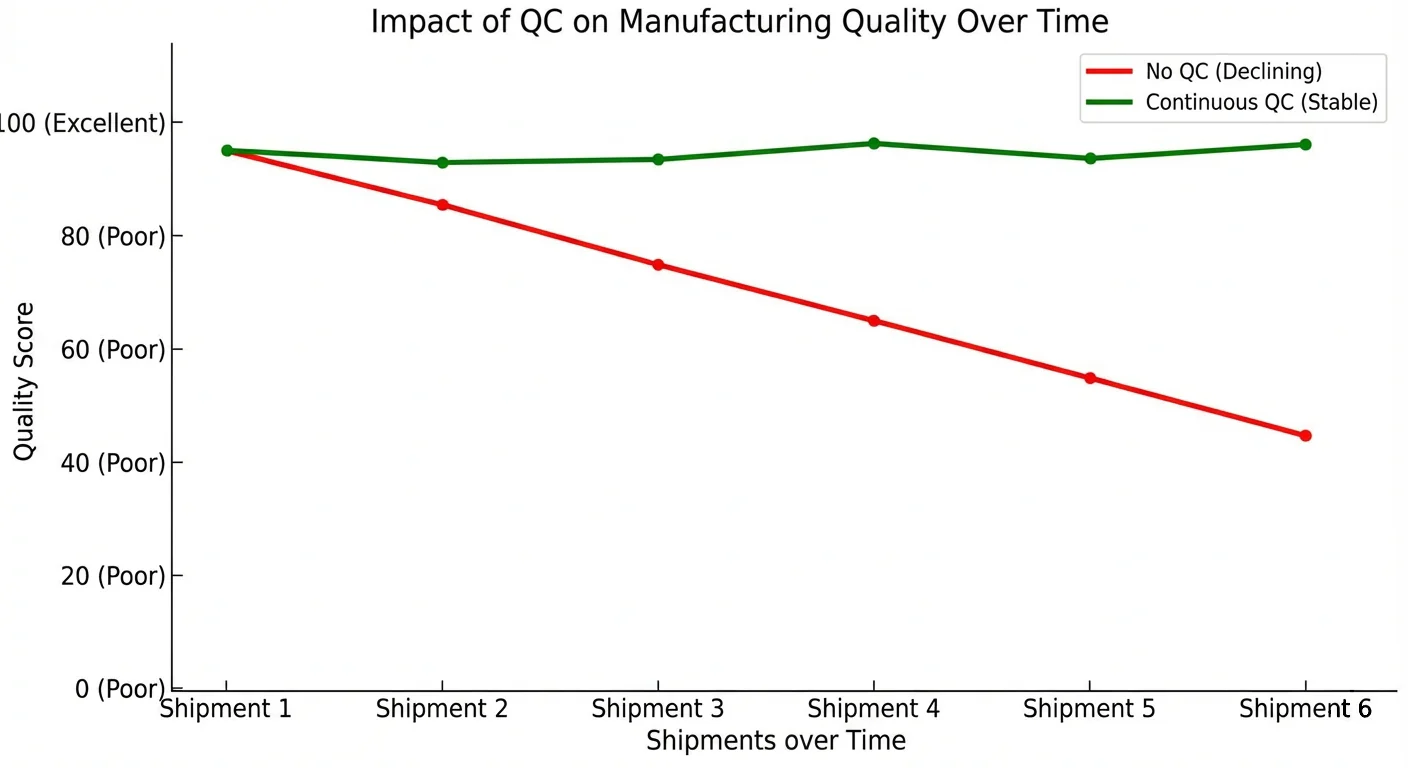
1. The “Quality Fade” Phenomenon
You might have experienced this before: The factory sends a perfect “Golden Sample.” The first production run is great. But by the third or fourth shipment, you notice subtle changes—cheaper materials, looser stitching, or slight color variations.
This is known in the industry as Quality Fade. It happens when suppliers quietly cut corners to widen their margins after they’ve secured your business.
- The Fix: Never get comfortable. Don’t just inspect the first batch; implement continuous quality control (QC). In 2026, relying on third-party inspections for every shipment (or random spot checks) is the only way to keep standards high.
2. Supply Chain Visibility (The Tier 2 & 3 Blind Spot)
In the past, you only needed to trust the factory you signed the contract with (Tier 1). Today, that’s not enough. You are now responsible for their suppliers too.
If your fabric supplier buys cotton from a region with forced labor issues (Tier 3), or if your electronics assembler buys conflict minerals (Tier 2), you are the one who gets in trouble.
- The Fix: Push for total transparency. Use digital platforms to map your supply chain down to the raw material level. If a supplier refuses to tell you where they get their materials, that is a major red flag.
3. Geopolitical & Tariff Instability
We live in a volatile world. A sudden trade war, a new tariff policy, or a port strike can wipe out your 15% cost saving overnight. Relying on a single country for 100% of your product is a gamble you can’t afford in 2026.
- The Fix: Diversify using the “China Plus One” strategy. Keep your main production where it is most efficient, but cultivate a backup supplier in a different region (like Vietnam or Mexico) who can ramp up production if borders close.
4. ESG and Regulatory Compliance
Environmental, Social, and Governance (ESG) is no longer just a “nice to have” for your marketing brochure—it is the law.
With strict regulations like the EU Supply Chain Due Diligence Act fully effective in 2026, companies can face massive fines for environmental damage or poor labor practices in their supply chain.
- The Fix: Audit before you sign. Ensure your suppliers hold valid certifications (like ISO 14001 for environment or SA8000 for social standards). Make ESG compliance a non-negotiable part of your supplier contract.
Step-by-Step Low Cost Country Sourcing Implementation Strategy
Moving production to a new country isn’t something you do on a whim. It requires a calculated, phased approach. Based on successful sourcing transitions in 2026, here is the proven four-step roadmap to get started without disrupting your business.
Step 1: The Feasibility Study (Calculators Out)
Before you even look for a factory, you need to look at the numbers. A common rookie mistake is focusing only on the Ex-Works (EXW) or FOB price.
- The Action: Run a comprehensive Total Cost of Ownership (TCO) analysis. You must calculate the “Landed Cost,” which includes:
- Logistics and freight insurance.
- Import duties and tariffs (Check the latest HS Codes for 2026).
- Inventory holding costs (longer lead times mean more cash tied up in stock).
- Quality control and travel expenses.
- Pro Tip: If the TCO savings aren’t at least 15-20% lower than your current setup, the switch might not be worth the risk.
Step 2: Supplier Selection (Go Beyond the “Golden Sample”)
Anyone can send a perfect sample—we call this the “Golden Sample.” It’s often handmade by the factory’s best technician, not mass-produced on the line. Never choose a supplier based on a sample alone.
- The Action: Conduct a rigorous Factory Audit. You (or a trusted third-party agency) need to visit the site.
- Check the machinery: Is it modern and well-maintained?
- Check the capacity: Can they actually handle your volume during peak season?
- Check the working conditions: Does it meet your ESG standards?
- Key Takeaway: You are not just buying a product; you are partnering with a process.
Step 3: Logistics Planning (Multimodal is Key)
In 2026, shipping routes are crowded and unpredictable. Relying solely on one shipping method is a vulnerability.
- The Action: Build a Multimodal Logistics Plan. Don’t just book ocean freight. Look at Sea-Air combinations (e.g., ship to Dubai, fly to Europe) or Cross-border Rail (especially from Asia to Europe).
- This gives you options. If the ports are congested, you can switch to rail. If you need speed, you can upgrade a portion of the shipment to air freight.
Step 4: The Pilot Run (Start Small)
Never jump straight into mass production. Even with the best factory, the first run will have issues—misunderstandings about packaging, color tolerances, or barcode labels are common.
- The Action: Insist on a Pilot Run (or Trial Order). Order a small batch (e.g., 500-1000 units) to test the entire system—from manufacturing quality to packaging durability and customs clearance smoothness.
- Treat this as a “stress test.” Iron out the wrinkles here so your main order runs smoothly.
Quality Fade Chart: Decline without QCFuture Trends: Sourcing in 2026 and Beyond
The sourcing landscape isn’t standing still. If you are still managing suppliers using Excel spreadsheets and email chains, you are already behind. Here is what the immediate future looks like for procurement.
1. Digital Sourcing (The AI Revolution)
The days of flying to a trade show and collecting business cards are fading. In 2026, Artificial Intelligence (AI) and Big Data are doing the heavy lifting.
- The Trend: Automated platforms now match buyers with suppliers based on millions of data points—historical performance, financial health, and even credit ratings.
- Real Talk: AI doesn’t sleep. It can monitor your supplier’s stability 24/7. If a supplier’s credit score drops, your system should alert you before they go bankrupt.
2. Sustainability First (Green is the New Gatekeeper)
Sustainability used to be a PR bonus. Now, it is a barrier to entry.
- The Trend: With regulations like the EU’s Carbon Border Adjustment Mechanism (CBAM) in full swing, “Green Manufacturing” is a requirement. Factories in LCCs are rapidly installing solar panels and water recycling systems to meet Western standards.
- Real Talk:”No Green, No Order.” If your supplier can’t prove their carbon footprint, you might not be able to legally import their goods into the EU.
3. Automation Levels the Playing Field
Here is a counter-intuitive fact: Robots cost the same in Vietnam as they do in Germany.
- The Trend: As “Low Cost Countries” adopt automation to combat rising wages, the labor cost gap is narrowing.
- Real Talk: The future isn’t about chasing cheap hands; it’s about chasing efficient machines. A fully automated factory in Mexico might offer a better TCO than a manual one in Bangladesh, simply due to lower error rates and higher speed.
FAQ about Low Cost Country Sourcing (2026 Edition)
Is China still considered a low-cost country in 2026?
Not strictly. China has graduated to a “Best Cost” country. While its labor wages are no longer the lowest, its infrastructure, mature component supply chain, and production speed are unmatched. For complex, high-tech products, China often remains the most efficient option despite higher wages.
How much can I realistically save with Low Cost Country Sourcing?
Generally, companies target a 15% to 30% reduction in landed costs. However, if your Total Cost of Ownership (TCO) calculation—which includes logistics, tariffs, and quality control—shows savings of less than 15%, the risks of moving usually outweigh the benefits.
What is the difference between Nearshoring and Low Cost Country Sourcing?
LCCS traditionally focuses on minimizing costs by sourcing from distant regions with low labor wages (like Southeast Asia). Nearshoring prioritizes speed and resilience by moving production to a country geographically close to the consumer market (like Mexico for the US, or Poland for the EU), often at a slightly higher cost than Asia but with much faster shipping times.
How long does it take to switch suppliers to a new country?
It is not an overnight process. A full transition typically takes 6 to 18 months. This timeline includes the feasibility study (1-2 months), supplier vetting and auditing (2-3 months), prototyping and pilot runs (3-6 months), and ramping up to full mass production.
What are the “hidden costs” of sourcing from low-cost countries?
The most common hidden costs include quality fade (requiring re-work or disposal), unplanned air freight (to make up for production delays), travel expenses for site visits, and cultural communication gaps that lead to specification errors. Successful sourcing managers factor a “risk buffer” into their budget to cover these.
Conclusion: Low Cost Country Sourcing is a Marathon, Not a Sprint
If there is one takeaway from this guide, let it be this: Low Cost Country Sourcing is not a quick fix.
In 2026, simply moving your factory to the cheapest location on the map is a recipe for disaster. It might look good on a spreadsheet for one quarter, but without a strategy for quality, logistics, and compliance, those savings will evaporate. Successful sourcing requires patience, discipline, and the foresight to build a resilient supply chain that can withstand the next global shock.
Don’t just chase the lowest price. Chase the best value.
Need to know exactly how much you can save? Stop guessing.
Navigating the complexities of global sourcing requires data, not intuition. At SoSourcing, we turn uncertainty into strategy.
Book a Free Consultation with our sourcing specialists today. We will help you run a preliminary Total Cost of Ownership (TCO) Assessment to see if moving production is the right move for your business. Let experts handle the heavy lifting while you focus on growth.